Tags:
“The mask maker’s daughter”
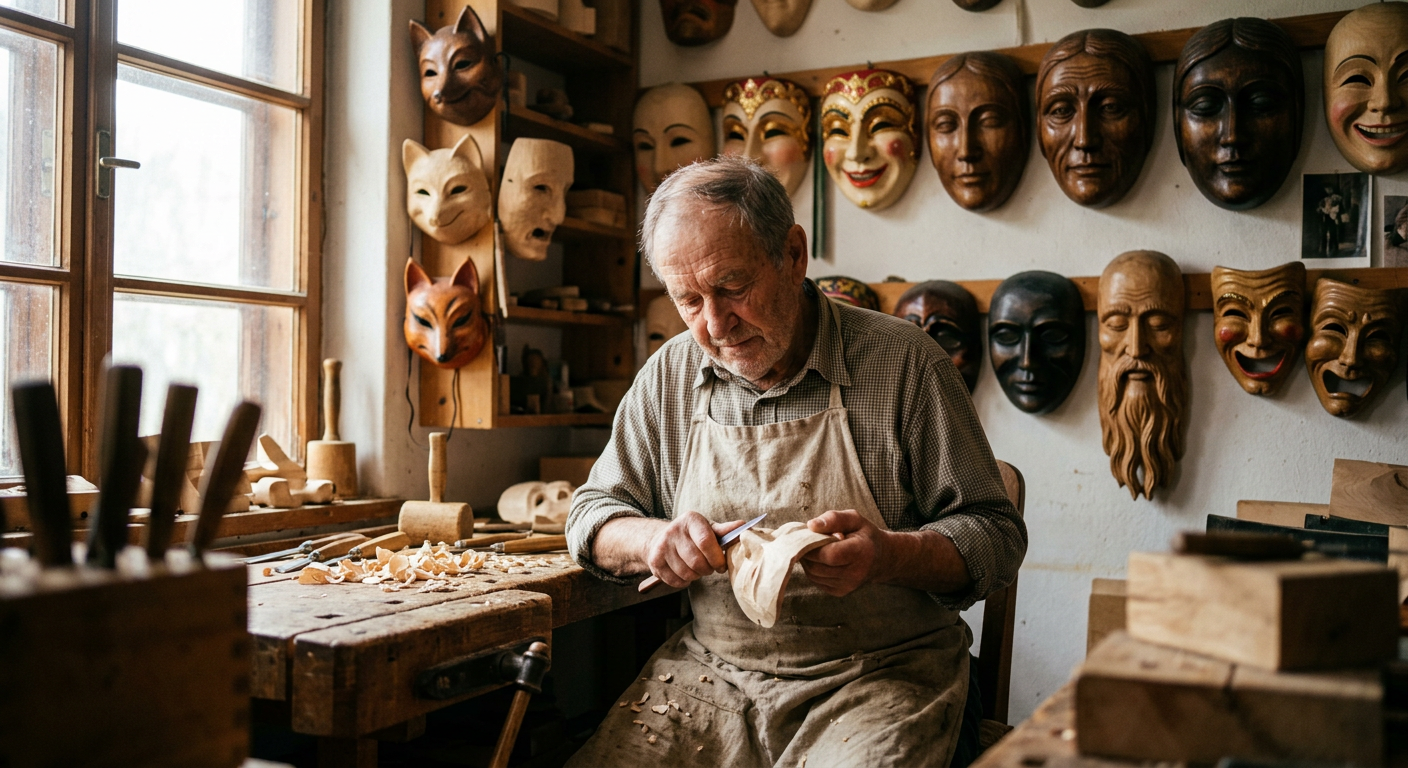
In a quiet town surrounded by forests and winding streams lived a craftsman known as the Mask Maker. For generations his family carved masks from smooth wood—beautiful pieces worn in festivals, theatre, and celebrations.
Each mask was different. Some smiled brightly, others looked wise or mysterious. People travelled from nearby towns to buy them, believing the Mask Maker possessed a rare gift.
His daughter, Elara, grew up in the workshop. As a child she loved the scent of cedar and the curls of wood scattered across the floor. She often sat nearby while her father carved.
One day she asked, “Why do people wear masks?”
Her father smiled gently.
“Sometimes to become someone else,” he said. “Sometimes to show a part of themselves they cannot reveal without one.”
When Elara was young, masks were playful. She wore them at festivals and laughed with the other children. But as she grew older, she noticed something strange.
Adults wore masks too.
Not wooden ones—but invisible ones.
She saw people smile while hiding sadness. She heard them agree with things they did not believe. Many seemed afraid to speak honestly, worried their truth might disturb others.
Elara wondered when everyone had learned to hide.
The First Mask
When she turned fifteen, her father gave her a carving knife.
“It’s time you learn the craft,” he said.
Her first mask was simple—soft white with calm eyes. When she finished it, she felt proud, yet uneasy.
“It’s perfect,” she said, “but it feels empty.”
Her father nodded thoughtfully.
“Perhaps,” he said, “it reflects something you have not yet seen.”
The Quiet Question
Years passed and Elara became skilled. Her masks were admired throughout the town. Yet the more she carved, the more she noticed how people hid behind their roles.
A merchant bought a cheerful mask, though his face looked tired when he removed it. A teacher purchased one of authority, yet privately seemed unsure of herself.
Elara began to wonder if her masks revealed something deeper—the ways people wished to appear.
Then she asked herself a harder question.
Had she begun wearing one too?
The curious child who once asked fearless questions had grown quiet, careful to say the right things and meet expectations.
Somewhere along the way, she had learned to hide her own truth.
The Forest
One evening Elara walked into the forest beyond the town. She followed the sound of a waterfall until she reached a peaceful clearing.
There she sat beneath a tall tree, listening to the wind and water.
The forest felt honest.
Trees did not pretend. The river did not hesitate. Birds sang freely without asking permission.
And suddenly she remembered running through these woods as a child—laughing, fearless, and alive.
Where had that freedom gone?
The Three Selves
As she rested there, memories rose gently within her.
She saw the bright child she once was.
She saw the searching teenager learning about the world.
She saw the adult she had become—skilled, admired, yet uncertain.
It felt as though three versions of herself stood together.
The child with wonder.
The youth with curiosity.
The adult with wisdom.
Slowly they began to merge.
Joy, curiosity, and wisdom blended into a single presence.
Elara realised something profound: authenticity was not about choosing one version of herself over another.
It was about allowing all of them to exist together.
A New Creation
When Elara returned to the studio, she looked at the masks hanging on the walls.
They were not wrong. People sometimes needed them for celebration or performance.
But they were never meant to be permanent.
She began carving a new mask.
Hours later she finished. It had calm eyes and a simple expression—neither smiling nor solemn.
It was not meant to hide behind.
It was meant to remind people to remove their masks.
She hung it above the studio door.
When visitors asked its meaning, Elara simply said,
“It reminds us that we already have a face.”
The Gift of Time
Years later Elara sat beside her aging father in the workshop. The carving had grown slower, the room quieter.
They spoke very little.
But the silence between them was warm.
She realised the greatest gift she could give him was not achievements or words.
It was time.
Just sitting together, listening to the wind through the trees and the gentle tapping of tools.
In that quiet presence, love spoke clearly.
The True Face
The workshop still stands in the little town by the forest.
People visit to see the masks carved by the Mask Maker and his daughter.
Yet the piece that stops them most is the one above the door.
Some smile when they see it.
Some grow thoughtful.
And some quietly remove the invisible masks they have been wearing.
Those who understand its meaning carry a simple truth back into the world:
The most beautiful face we can show the world
is the one we were born with.
When we live with honesty, presence, and love, we become what our soul always intended.
We were never meant to hide our light.
We were meant to share it.
Audio
Elara walking in the forest:
“The Courage to Live Unmasked — Presence, Authenticity, and the Sacred Gift of Time”
The central thread woven throughout this service (8th March 2026) is the invitation to return to one’s authentic self and to live consciously in the sacred present moment. The message gently reminds us that life is not something to wait for, postpone, or perform—it is something to experience fully and truthfully.
The Inspiration Guidance, “Nourish the Soul, Drink in Life,” teaches that the direction of our lives is shaped not by circumstance but by the focus we choose to hold. Attention itself becomes a spiritual instrument. When our awareness rests in love, hope, and faith, life reflects those qualities back to us. This is not power over others, but the quiet spiritual authority to choose how we perceive, interpret, and respond to life.
The guidance titled “Reveal Your Truth” expands this teaching by acknowledging that many people gradually learn to hide their authentic nature behind social expectations and inherited beliefs. Masks of agreement, compliance, or fear may protect us temporarily, yet they also dim the natural radiance of the soul. The service therefore calls us to gently remove those masks and rediscover the truth that existed before we learned to conceal it.
This process is not rebellion but liberation. Each time we honour our true thoughts, feelings, and inner knowing, we step closer to the brilliance with which our soul first entered the world.
The meditation journey reinforces this teaching by guiding participants through a symbolic integration of the inner child, the adolescent self, and the adult self. These three aspects of our identity—innocence, discovery, and wisdom—merge into a single harmonious being. Healing occurs when we allow all parts of ourselves to be acknowledged and welcomed rather than fragmented or suppressed.
Through forgiveness and self-acceptance, the meditation restores the natural alignment of body, spirit, and soul. This wholeness becomes the foundation for living authentically.
The story, “The Gift of Time,” provides a simple yet profound illustration of this truth. The person in the story discovers that the most meaningful gift we can offer another is not possessions, advice, or elaborate gestures, but presence itself. When we slow down enough to truly sit with someone—listening, observing, sharing silence—we honour the sacredness of connection.
Time, when given consciously, becomes love made visible.
Finally, the reflection on the Gentle Veil reminds us that even the boundaries between life and death are softer than we often believe. Those who have crossed into Spirit are not lost; their presence continues through memory, energy, and love. When we become still enough to listen, we recognise that love is timeless and ever-present.
Core Lesson
🜂 Authentic living begins when we release the masks we were taught to wear.
🜂 True connection grows through presence, not performance.
🜂 When we give our attention fully—to ourselves, to others, and to Spirit—we rediscover the wholeness that has always lived within us.
To live authentically is not to become someone new;
it is to remember who we were before the world asked us to hide our light.