Tags:
The Lantern That Knew Its Name
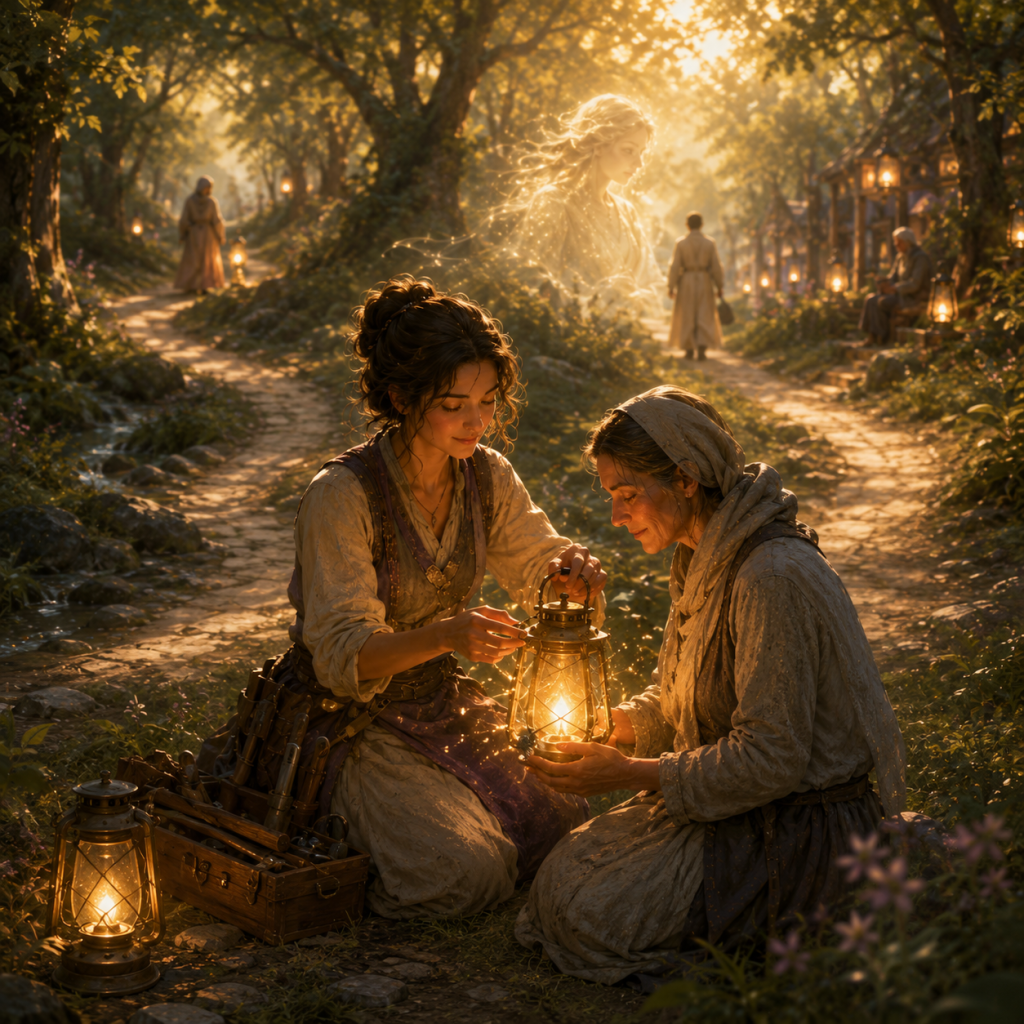
In a village set between the edge of an old forest and the bend of a clear running stream, every person carried a lantern.
No one remembered when the custom began. Some said the flame came from the Great Light that breathed life into everything. Whatever the truth, the people believed that a person’s lantern showed who they were.
When a child was born, the family brought a small unlit lantern to the village square. Friends gathered, prayers were spoken, and the elders placed a spark inside the glass. As the child grew, others began tying little tags to the lantern handle.
“She is clever.”
“He is difficult.”
“She is quiet.”
“He is brave.”
“She is not like her sister.”
“He will never change.”
At first the tags were small. Over time, they became so many that some people could barely see the flame inside. The labels knocked against one another as people walked. Some labels were golden and made the bearer stand taller. Others were dark and heavy, and made the lanterns swing low.
A young woman named Mira repaired lanterns in a narrow shop near the stream. She could mend cracked glass, straighten bent frames, and polish smoke-stained panels until light shone through. People came from across the village with their lanterns held out.
“Can you make mine brighter?” they asked.
Mira always tried.
Yet each evening, after the shop bell stopped ringing and the village settled into silence, she looked at her own lantern and felt troubled. It was covered in tags.
Useful.
Dependable.
Too sensitive.
Not enough.
Always helping.
Still unfinished.
The words had been placed there by many hands. Some were kind. Some were careless. Some had been tied by Mira herself after shame, comparison, or fear. She had worn them so long she no longer knew which ones were true.
One afternoon, just before the winter rain arrived, an old traveller entered the shop. Her cloak was silver at the hem, as though it had brushed moonlight, and she carried no lantern at all.
Mira noticed this immediately.
“Forgive me,” she said, “but where is your lantern?”
The old woman smiled. “Closer than you think.”
Mira glanced around the room, unsure whether the traveller was making a joke.
“I repair lanterns,” Mira said. “If yours is broken, I can help.”
“That is why I came,” the woman replied. “Not because mine is broken, but because you believe yours is.”
Mira looked down at her own lantern. The tags clattered softly in her hands.
“It is not broken,” she said. “Only crowded.”
“Crowded with other people’s answers,” the traveller said. “But I wonder whether you have asked the right question.”
Mira frowned. “What question?”
The old woman stepped closer and touched one finger gently to the glass. The flame inside Mira’s lantern flickered, not weakly, but as if it had recognised a friend.
“Who are you,” the traveller asked, “when no tag is speaking?”
Mira felt the question pass through her like wind through an open doorway.
“I am a lantern mender,” she said quickly.
“That is what you do.”
“I am my mother’s daughter.”
“That is a beautiful relationship, but not the whole of you.”
“I am someone people rely on.”
“That is how others meet you.”
Mira had no answer after that.
The traveller did not press her. She simply said, “At dawn, walk into the forest until you find the stream where the stones are white. Bring your lantern, and bring no one else’s opinion with you.”
That night, Mira slept little. She dreamed of hundreds of tags whispering all at once, each trying to name her. Some praised her. Some accused her. Some begged her not to change. Beneath them all, she heard a softer sound, like a flame breathing.
At dawn, she took her lantern and walked into the forest.
The trees were tall and still. Rain rested on the leaves, catching the early light. The path curved between ferns and moss-covered stones. With each step, Mira became aware of how much noise she carried inside. She heard old criticisms, old fears, and old expectations, as though she were not already something sacred.
At last she found the stream. Its water ran clear over white stones, singing quietly to itself. The old traveller stood beside it, waiting.
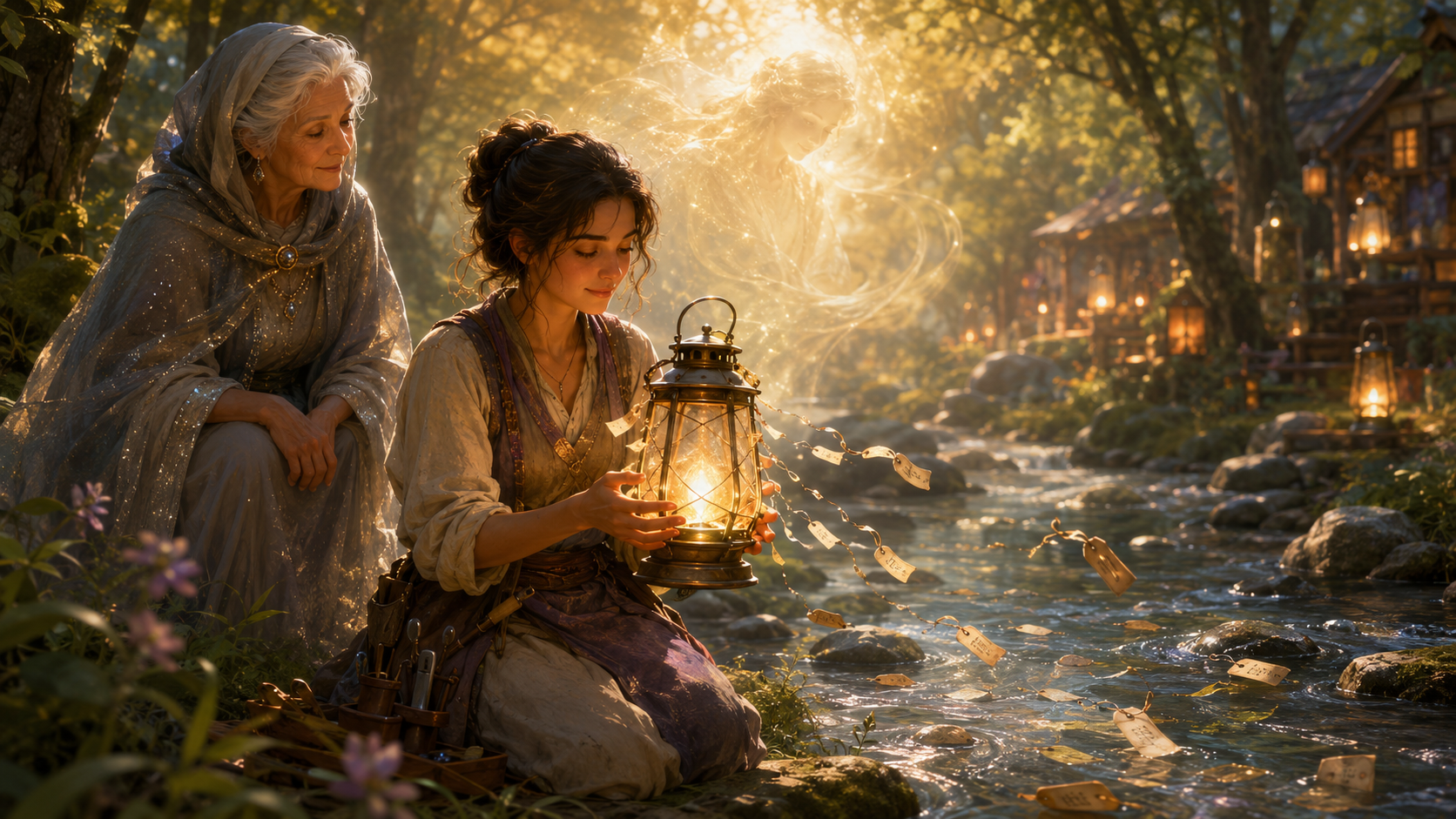
“Place your lantern in the water,” she said.
Mira hesitated. “The flame will go out.”
“Not the true one.”
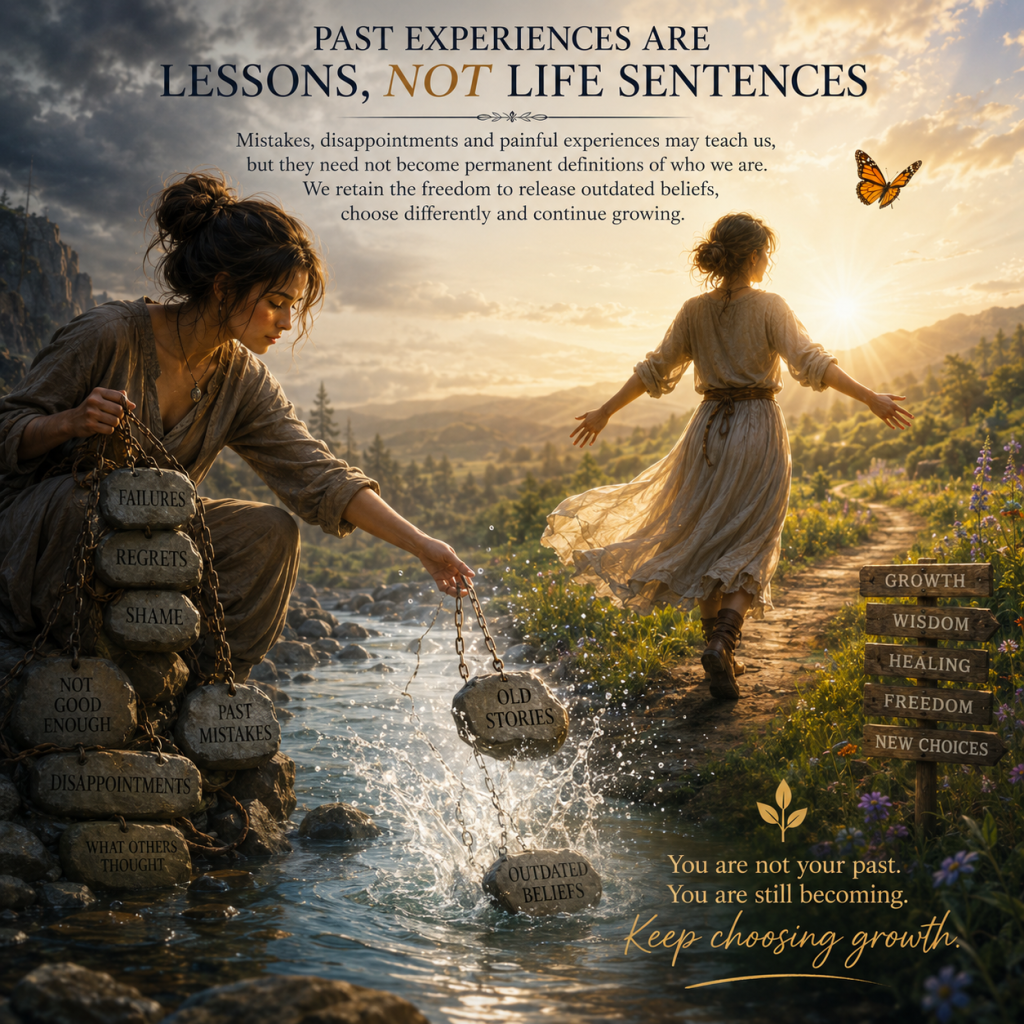
Her hands trembled as she lowered the lantern into the stream. The water moved over the glass, around the iron frame, and through the tangle of tags. One by one, the knots loosened.
Too sensitive slipped away first.
Then not enough.
Then unfinished.
Mira reached for that one, almost afraid to lose it. She had carried it for so long that it felt like protection.
The traveller watched her kindly. “A lesson is not a life sentence.”
Mira let it go.
More tags drifted downstream. Some of the golden ones went too: admired, needed, impressive. Mira was surprised by how hard it was to release those.
“But they are good labels,” she said.
“They may be pleasant,” the traveller replied, “but even praise can become a cage if you mistake it for your soul.”
When the last tag floated away, Mira lifted the lantern from the water. The flame remained, clearer than before, steady and warm behind the glass.
Mira stared at it. “What is it?”
“It is the part of you that was never made by the village,” said the traveller. “It is the soul-light. It learns through the life you live, but it is not limited to your mistakes. It shines through your body, but it is not ended by the body. It is inspired by the One Light, and it remains connected to that Light always.”
Mira’s eyes filled with tears. “Then why do we forget?”
“Because Earth is a place of learning,” the traveller said. “Here, people discover love by choosing it. They discover kindness by offering it when judgment would be easier. They discover truth by listening within, not merely repeating what others have told them. Forgetting is not failure. It is often the beginning of remembering.”
Mira sat beside the stream for a long while. She thought of the villagers who came to her shop. The proud man whose lantern was wrapped in titles. The grieving mother who had tied the name of her lost son to her handle, not as a burden, but as love. The boy who had been called difficult so often that he had begun to walk like a locked door.
Mira suddenly understood that she had been polishing glass while leaving the labels untouched. She had helped people see their flames more clearly for a moment, but she had never told them they were more than the words tied to them.
The traveller turned towards the deeper forest. “There is one more thing to see.”
They walked until the trees opened into a small clearing filled with light. It did not seem to come from the sun alone. It rose from the earth, rested in the air, and moved through Mira’s breath. In that light, she felt known without being judged. Nothing about her was hidden, yet nothing was condemned.
For a moment, she sensed her father, who had passed into Spirit when she was young. She did not see him as plainly as she saw the trees, yet she felt the familiar warmth of his hand around hers, the kindness of his laughter, the love that had never ended.
Mira whispered, “I thought losing him meant the light had gone.”
The traveller’s voice was gentle. “Love changes form. It does not die.”
Mira closed her eyes. The ache in her heart did not vanish, but it softened. Grief was not proof of separation. It was proof of love reaching across a doorway she could not yet fully see.
When she opened her eyes, the traveller was standing a little way off.
“Who are you now?” the old woman asked.
Mira looked at her lantern. No tags. No borrowed names. Only flame.
“I am a soul,” she said slowly, “learning through love.”
The traveller smiled.
“I am free to choose,” Mira continued. “Free to grow. Free to listen. Free to forgive. I am not here to become someone else. I am here to remember the light already within me.”
The clearing brightened, as though the forest itself had heard.
When Mira returned to the village, people noticed the change immediately.
“Your lantern looks empty,” said the butcher.
“No,” said Mira. “It is clear.”
The next day she placed a small sign in her shop window:
Lanterns repaired.
Labels loosened.
Flames honoured.
Curiosity brought people in.
A young mother arrived carrying a lantern covered in the words should, must, and everyone expects. Mira invited her to sit by the workbench.
“Before we mend anything,” Mira said, “tell me which of these words belongs to your soul.”
The woman began to cry, not because she was broken, but because no one had asked her that before.
An old farmer came next. His lantern was bright, but he had wrapped it in the tag failure after losing a season’s crop.
“Did the earth call you failure?” Mira asked.
“No.”
“Did the rain?”
“No.”
“Then perhaps the word came from pain, not truth.”
The farmer untied it himself.
Weeks passed. The village slowly changed. People still worked, argued, learned, grieved, celebrated, and made mistakes. No one became perfect. Yet they began to speak more gently. Parents became slower to tie careless words to their children’s lanterns. Friends became braver in removing labels they had outgrown.
Each evening, Mira walked to the stream and gave thanks. Sometimes she felt her father near. Sometimes she felt only peace. She learned not to force the presence of Spirit, but to welcome it with an open heart. Love, she discovered, knew its own way of arriving.
Years later, when Mira was old, a child came into her shop holding a lantern nearly hidden beneath bright and heavy tags.
The child looked at Mira and asked, “Can you tell me who I am?”
Mira remembered the traveller, the white stones, the stream, and the light that did not judge.
She knelt so her eyes were level with the child’s and smiled.
“I cannot tell you who you are,” she said. “But I can help you become quiet enough to remember.”
Together they carried the lantern to the stream.
And as the water began to loosen the first knot, the child saw a small, steady flame shining within the glass.
Not borrowed.
Not earned.
Not fragile.
Not alone.
A soul-light.
And somewhere beyond the trees, in the unseen nearness of love, the old traveller smiled.